Can we rebuild ‘the Plebs League’ tradition? Summary 24th November meeting
A really engaging and important day event was held at Northern College, an adult education college outside Barnsley, organised by the Independent Working Class Education (IWCE) Network
This was the eighth such event with an ninth planned for 2 February 2013 in London. This project aims, as the website states, ‘to learn the lessons of history to inform current class struggle’. Clearly this project aims to inform, enhance and critique the work of education activists in informal (i.e., trade union, adult and worker) and formal education (such as university lecturers—as the last talk of the day by Colin Waugh indicated). At a time when the world and its people faces multiple crises (ecological, economic, political), when activism in many nations is uneven and struggles could be much more interconnected, education to help build such struggle is of utmost importance.
The day was organised in an open, welcoming and non-sectarian way through both small group discussions and speakers’ talks. Almost all speakers and participants are or were involved with education, and expressed concern about how formal and informal education are increasingly compromised and co-opted spaces where students are to be taught ‘skills’ they supposedly need for entry to the (shrinking) job market they seek to enter after graduating/completing educational processes (at a dramatically rising cost). As Colin Waugh, one of the IWCE co-organisers (Keith Venables is the other), pointed out in his very important pamphlet, ‘Plebs’: the lost tradition of independent working class education (http://www.ifyoucan.org.uk/PSE/Home_files/PSE%20Plebs%20pamphlet.pdf this radical alternative is part of a wider and longer process of working class people developing ‘really useful knowledge’ to counter elite efforts to contain working class resistance (Johnson 1989).
The first two speakers discussed how they had been positively transformed by formal education, a process that led them to become trade union educators committed to facilitate others’ political understanding and action. Allen Roe spoke of his pleasure in realising that he had educational potential after the formal education system failed him, a realisation he has long utilised as a trade union educator seeking to help generate students ‘intellectual and political development. Dave Berry discussed how, as a new shop steward, he was introduced to Robert Tressell’s The Ragged Trouser Philanthropists, which, like other fictional (and non-fictional) works, profoundly deepened his appreciation of the history of working class exploitation and resistance in the workplace. He noted that such accounts continue today, as indicated by Louise Raw’s (2011) Striking a light: the Bryant and May Matchwomen and their place in history. The clear ideological bent of these kinds of books, Berry noted, reveal the continuity of capital’s exploitation of labour. Alongside such books is a strong and enduring working class oral tradition through which insights gained from one generation of workers are passed on to the next. Berry argued that both of these learning tools (and, I would add, virtual material) can potentially contribute to greater worker consciousness of their conditions and possibilities for resistance.
If awareness of the past is crucial for understanding the present as Roe and Berry noted, then the third speaker (Hilda Kean, former Dean of Ruskin College, a progressive working class college created in Oxford in 1899) revealed how the working class past remains under attack today. Kean spoke about the recent shredding of some of Ruskin College’s archives by the current College Principal. Kean cited Brecht’s poem, ‘Questions from a worker who reads’, as indicative of the ways that dominant history has long rendered invisible working class contributions as warriors, workers and slaves to ruling class victories in battles, monumental buildings and daily sustenance (https://www.msu.edu/~sullivan/TransBrechtWorker.html ). For Kean the Ruskin archives were ‘like gold dust to labour and social historians enabling a better understanding of the political and cultural life of working class people in the twentieth century’ (http://www.historyworkshop.org.uk/whose-archive-whose-history-destruction-of-archives-at-ruskin-college-oxford/). The destruction of student admissions and trade union records, as well as dissertations, has eliminated some aspects of working class activist history from present and future generations. This need not have happened; institutions that had already taken some Ruskin archives (i.e., Manchester Working Class History museum, and Bishopsgate Institute) reportedly would have housed these additional archives. The current Principal’s recent statement that ‘‘we must live by our future’, speaks, Kean noted, to the ongoing wider disavowal of, and severance from, Ruskin’s activist past. Indeed, the archive shredding is part of a wider, literal eradication of Ruskin’s roots as the College’s central Oxford site has recently been sold to Exeter College and the College is now being moved to the outskirts of the town.
The shredding of Ruskin College’s ‘gold dust’ was a theme echoed by the fourth speaker, Alex Gordon, President of the Rail Maritime and Transport (RMT) union. Gordon viewed this destruction as a deliberately ‘hostile act’ aimed at erasing earlier working class educational and political activity. Ruskin was important for the RMT; its 1905 forebear, the Amalgamated Society of Railway Servants (ASRS), sponsored students to attend Ruskin. Those trained at Ruskin helped organise the 1911 national strike of 70,000 rail workers that forced the then Liberal government to set up a royal commission to examine workers’ frustration with the 1907 Conciliation Board ostensibly set up to negotiate rail workers and managers’ disputes.
Gordon claimed that the RMT commitment to progressive education by and for workers continues’; despite the fact that other unions are pulling out of education centres, the RMT has recently completed a new college in Doncaster. The RMT recognises the need forthcoming generations of workers to understand their past in order to help build a better future—which Gordon maintains is needed in the current era of massive attack on workers more than ever Edd Mustil, the fifth speaker, discussed the pre-World War I proliferation of socialists in political groups and of radical authors and activists (like those of the early 20th century ASRS of whom Gordon spoke). Education, through public meetings, classes and pamphlet publications, was seen as central to the work of political groups such as the Social Democratic Foundation, the Independent Labour Party and the British Socialist Labour Party. This was the era when labour Sunday Schools, Clarion Choirs and newspapers were popular, when radical tracts like Oscar Wilde’s (1891) The soul of man under socialism (http://www.marxists.org/reference/archive/wilde-oscar/soul-man/index.htm) were circulated, as were the writings by the Czech/Austrian Marxist economist, Karl Kautsky, and those of the radical American writer Henry George. Left activists and writers such as the Irish dramatist and pamphleteer George Bernard Shaw and the Scottish socialist John Maclean, writers/educators who believed that being an activist and going on strike was essential to working class education, gave lectures respectively to Irish and Scottish workers. the heart of all these efforts was the belief that an independent working class movement needed to become more aware of its long history of struggles between labour and capital so that workers could help build a radically different, more egalitarian, society. I have little doubt that this is a belief that has motivated Venables and Waugh to create the Independent Working Class Education project.
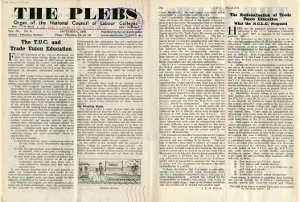
The final speaker, Colin Waugh, raised important questions for the recent emergence of popular universities aiming to realise alternatives within, against and beyond the public university. Waugh cautioned these educators to heed the lesson learnt by the 1908 Ruskin College strikers, who, nine years after the College’s creation, expressed their dissatisfaction with how the Ruskin educational programme served to contain working class resistance to ruling class power. Workers, along with the then Ruskin Principal, Dennis Hird, broke from Ruskin and set up the Plebs League that became part of the Central Labour College. The latter was supported by mining and rail unions and created an educational programme that aimed to promote working class resistance (as Gordon’s talk suggested). The Plebs League, which lasted until 1964, was itself part of a wider upsurge of working class educational programmes at home and abroad, such as the Ferrer Circle created in Turin in 1910 that promoted political and cultural education (http://libcom.org/history/maurizio-garino-1892-1977).
Waugh’s talk thus urged those attempting to create alternative educational programmes at all levels today to consider whose interests the education they are creating serves, and to place praxis at the centre of their efforts. Waugh pointed to Antonio Gramsci’s critique of working class educational alternatives such as the so-called popular university of Turin that, Gramsci noted, was neither ‘a university nor popular’ (Gramsci, 1916). It did not consider working peoples’ prior educational history but only their creators’ beliefs about the education they thought workers needed. Knowledge was presented as facts, desiccated bits of information, detached from their contexts that, ‘like food parcels . . . [may] fill the stomach, perhaps cause indigestion, but then leave no trace, bring abut no change in peoples’ lives’ (Gramsci, 1916). Teachers thus did not view knowledge as an historical process that students could help deepen by reading/thinking and by engaging in ‘act[s] of liberation’ (as had prior thinkers/researchers). Based on Gramsci’s work, and his own research on the Plebs League, Waugh thus argued that formal and informal educational alternatives in today need to be forged from and for below, connected to and continuing economic and political struggles. They must link theory and practice with the aim of contributing to a process of radical transformation of working class people’s conditions today.
Several apologies were sent for non-attendance on the day. Amongst them was a supportive document from Owen Smith, Labour MP. Hopefully, the next event will showcase a brand new IWCE Website: 2nd February.
References Brecht, B. Questions from a worker who reads, https://www.msu.edu/~sullivan/TransBrechtWorker.html. Gramsci, A. (1916) The popular university, http://terrywassall.org/blogs/notes/2011/06/02/the-popular-university-gramsci-1916/. Garino, M. Maurizio Garino, 1892-1977, http://libcom.org/history/maurizio-garino-1892-1977. Johnson R. (1981) ‘Really Useful Knowledge: radical education and working class culture 1790 – 1848’ in Dale R et al (ed) Politics Patriarchy and Practice: education and the State vol. 2, Basingstoke: Falmer Ford/OU Press. Kean, H. (2012) Whose archive? Whose knowledge?: the destruction of archives at Ruskin College, http://www.historyworkshop.org.uk/whose-archive-whose-history-destruction-of-archives-at-ruskin-college-oxford/. Raw, L. (2011) Striking a light: the Bryant and May matchwomen and their place in history, London, New York, New Delhi and Sydney: Bloomsbury Press. Tressell, R. (2005) The ragged trousered philanthropists, Oxford and globally: Oxford World Classic Paperback. Waugh, C. (2010) ‘Plebs’: the lost legacy of independent working class education, A Post-16 Educator occasional publication, http://www.ifyoucan.org.uk/PSE/Home_files/PSE%20Plebs%20pamphlet.pdf (Joyce Canaan, Birmingham Radical Education 15 December 2012)