
Introduction
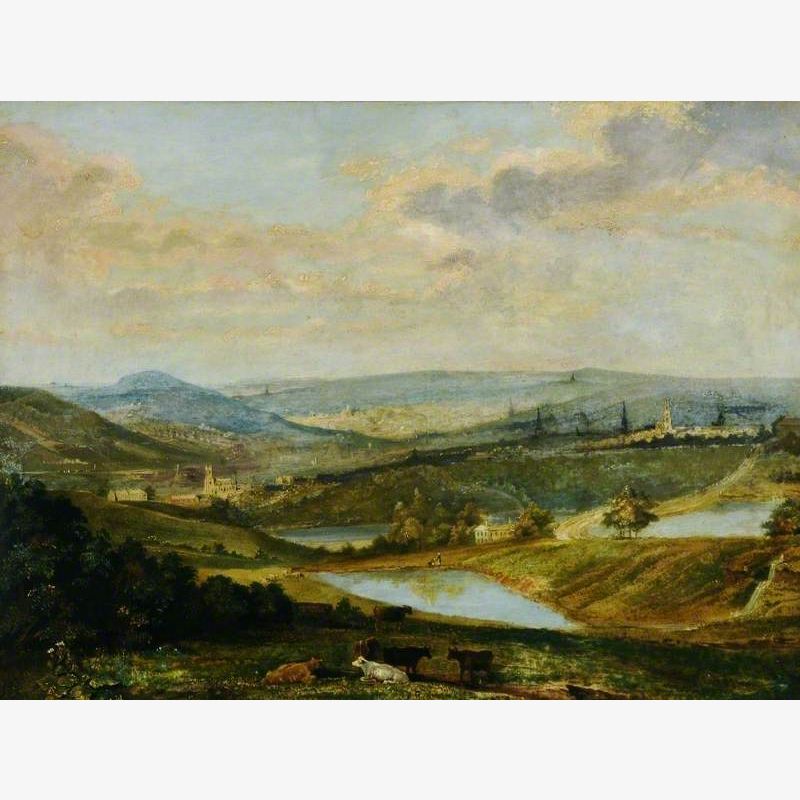
Picture by William Ibbitt showing Sheffield’s early development with Crookesmoor Reservoir and Dam House in centre (1856):
Credit:Sheffield Museums
During the 19th century, Sheffield’s population increased dramatically from a town of 45,000 to a city of almost half a million people.. This came about for two main reasons – firstly, couples were marrying at an earlier age, so more children were being born, but secondly -and more importantly – there was a great deal of migration into Sheffield, with people moving here for work. Employment opportunities were good. There was certainly a demand for more and more workers as the steel and engineering industries expanded and new large-scale factories were built. Although some immigrants came from far afield to try their luck in Sheffield, most arrived from adjacent agricultural counties, where jobs in farming were being lost due to the repeal of the Corn Laws and enclosure of common land. However, they were often unskilled in the metal trades, and the influx of all these new people sometimes caused problems with the existing Sheffield workers.
Given that everyone was crowded into closely-packed areas around the workshops and factories,
these less than ideal living conditions could make it difficult for newcomers to settle into their new lives.
There was some emigration from Sheffield – for example, cutlers going to America in the hope of higher
wages and a better quality of life – but in general the movements made by an increasingly mobile UK
population were from country to town, and from farming to manufacturing. The majority of people now
came to be concentrated in large towns rather than living more isolated lives in countryside areas, as had
previously been the case. This was the beginning of Sheffield’s growth to city status.
This YouTube clip gives an idea of what Sheffield was like in the 1850s. Talking Art by Sheffield
Museums at Talking Art: South East View of Sheffield by William Ibbitt
The problems of growing towns
Sheffield had its fair share of problems as its population grew. By the middle of the 19thcentury the built-up area in the centre couldn’t really accommodate any more people, as it was already full of residential and industrial properties. The outskirts were also starting to fill up with new factories, and still there was the problem of where to house the workers needed for these expanding industries. So with no overall plan in place, the race was on to build plenty of cheap houses as quickly as possible, preferably close to the
workshops and factories where people were employed. Unfortunately the new residential areas were
squalid, falling short in a number of ways: there was an erratic supply of those utilities such as gas and
water, which we take for granted today; there were inadequate sanitary arrangements with houses
frequently not connected to drainage and sewerage systems; there was no reliable street cleaning or
rubbish collection; houses were badly designed and poorly-built; the general environment (land, air and
rivers) was polluted, leading to poor health and high mortality rates for Sheffield residents; finally there
were hardly any green spaces for the population to enjoy in the small amount of leisure time that they had.
The progress that came from advances in manufacturing certainly had a detrimental effect on much of the
population, both in terms of each individual’s quality of life, and on his local environment.
Providing services in growing towns
As the century progressed, and particularly after 1893 when Sheffield became a city, some of the
problems which had blighted the lives of the fast-growing population were starting to be addressed. This
led to the provision of amenities such as baths and wash-houses. Upperthorpe Baths was opened in 1895,
and was situated next to the public library, built some 20 years earlier. The building housed a swimming
bath, and a number of what were called slipper baths. These were free-standing bath tubs, where people
could pay to take a bath. There were two levels of service, which would reflect things like how many
towels you were given, and the type of soap. Public baths were aimed at those people in the population
who had no indoor plumbing and no space for a fixed bath at home. This of course would be most of the
working-class population. There was also a public wash-house on the Daniel Hill side of Upperthorpe
Baths, where people could come and do their laundry. This was another hard and time-consuming job if
there was no piped water-supply in the house, and of course no hot water. Services such as these helped
people in challenging circumstances to keep themselves and their clothes clean.
People understood the connexion between keeping things clean and being healthy, and of course health
was an important issue. Sheffield’s first actual hospital was the Infirmary, built by public subscription and petition was located in the countryside when it opened in 1797. (Earlier institutions going by the name “hospital” were in fact almshouses.)
Some 30 or so years later, it became clear that the Infirmary couldn’t adequately meet
the medical needs of the growing population, so a Public Dispensary was opened, also by public
subscription, in 1832. (This eventually became the Royal Hospital, which closed in 1978 when the
Hallamshire Hospital opened.) As medical knowledge grew in the 19th century, various specialist hospitals
and units were established. Medical care was also provided by publicly-funded workhouses at Fir Vale
(which became the Northern General Hospital) and at Nether Edge. Access to medical services was as
follows: if you were poor, you went to the medical facilities in the workhouse; if you were wealthy, you paid for a doctor to visit at home. Note that before you could get treatment from one of the subscription-
funded hospitals (unless it was for an accident) you had to obtain a recommendation from one of the subscribers.
Further new hospitals, or extensions to existing hospitals, were built in the 20th century. Sheffield became
an important centre for medical education and for research, with doctors taking a particular interest in the
causes of and treatments for common industrial diseases. The aim was to make places of employment
safer, and to stop so many workers dying young.
Transport
Other ways in which people’s lives improved during the last quarter of the 19th century occurred through changes to transport systems and roads. Earlier in the century the main forms of transport were horse-
drawn vehicles of various kinds. Some roads were little more than poorly made tracks; others were main turnpike routes with tolls to be paid by the user. Then from 1873 there were privately-run horse-drawn
tramways in the town, but this did not create a proper system for local passengers, and many people just
walked everywhere. Other developments in communications such as canals and railways had more of an
impact on freight rather than human passengers. Eventually the 1880s saw the abolition of tolls on
turnpike roads, and then in 1896 the horse tramways in Sheffield were brought under public control. The
local authority improved, extended and electrified this tramway system, with the first electric tram
running in 1899. Putting on electric trams meant that steeper gradients could be tackled, which was
important for Sheffield! Horse-drawn trams went out of service in 1902. As part of the necessary work to
get the electric tramway up and running, new roads were made, and existing ones improved or widened. A
consequence of now having a good public transport system was that people were not always forced to live
close to their place of work; in theory they and their families could move out of the unhealthy industrial
parts of Sheffield, and into more pleasant areas.
During the Edwardian period rapid expansion of the tramway system occurred; trams became more
comfortable and were very well used by Sheffield people. However, in spite of their popularity, some
trams started to be replaced by buses, and the feeling grew that integrating a tramway on the same stretch
of road as other vehicles (whose numbers were increasing) was problematic. So the Sheffield tram system
finally closed in 1960.
Getting the vote
In many ways working people’s lives were improving during the 19th century, but because the working class were for a long time denied the vote, there was a power imbalance between different classes in the
population. In addition to these class differences, men and women were also treated unequally when it
came to the political influence they had, and the civic duties which each was permitted to take up.
Before the 19th century the franchise was restricted to a very small number of property-owning men.
Various protest movements for reform grew from the Chartist movement, trade unions and women suffragettes. This pressure brought about change through a series of Reform Acts passed during the 19thcentury and early 20th century. Male voting rights were extended through the Reform Act of 1867 and in
1918 all men aged 21 and over were granted the vote, with no property restrictions in place. At the same
time women over the age of 30 who met certain property qualifications (or whose husbands did) were also
allowed to vote. It was only in 1928 that women achieved the vote on the same terms as men. In 1918 another important piece of legislation was passed which allowed women to stand for election to
Parliament. (A previous act from 1911 had introduced payment for Members of Parliament).
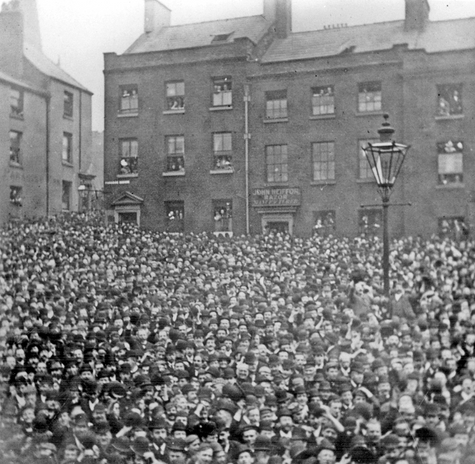
A mass political meeting in Paradise Square sometime in the late 19th century. The square was often used by large groups to hear public speakers.
Taken from the balcony of the Middle Class School: Libraries Sheffield
However,this wasn’t the first legislation permitting women to play a part in civic and political affairs. The 1869 Municipal Franchise Act allowed female ratepayers (that is, widows and unmarried women) to vote in local elections. Married women were not included because it was felt that their husbands’ vote was sufficient. Later the 1894 Local Government Act allowed all women to vote and to serve on councils and local bodies of various sorts. As a result of this legislation, Mrs Sarah Ruth Wilson was elected in 1882 to the Sheffield School Board, and Mrs Elizabeth Chappell was elected as a Sheffield Poor Law Guardian.
Gradually women took on positions of responsibility locally, even though they were often ridiculed for campaigning for universal suffrage.
Sheffield was quite a radical place, and women here were very active in all branches of the suffrage movement, including the militant wing. Many Sheffield women organised events and went to prison as a
consequence. Suddenly all this activity came to an end when war was declared in the summer of 1914, and the suffragettes abandoned their struggle for now, throwing themselves into giving support to the war
effort. Finally there followed the 1918 legislation giving the vote (unequally) to all adult men and some adult women; then in 1928 electoral equality was achieved.
Arnold Freeman’s work
One consequence of World War One was certainly the changing position of women. Along with this was
the desire to do something about the inequality between the classes and hence to improve the lives of
ordinary people. In some quarters nothing less than a reconstruction of society was called for. However,
the postwar period was one of social and economic distress; the country was bankrupt and many
ambitious social schemes came to nothing. Into that world stepped Arnold Freeman. He believed he knew
the answer to an important question that was in people’s minds: how was everyone to live a satisfying and
productive life? Freeman arrived in Upperthorpe towards the end of World War One, and became warden
of the Sheffield Educational Settlement, where he tried to put his ideas into practice.
He wanted his Settlement to be accessible to everyone in the locality, and to be important to that locality.
He felt that part of its work should be to do research about the area, in order to gain knowledge of what its
problems were, so as then to be able to influence how local issues might be tackled. He thought it was
important for people to be good workers, responsible members of households, and useful citizens. He
recognised that most people hadn’t received the sort of education that would prepare them to be that kind
of adult, so he set about organising activities which would encourage people to develop skills and
therefore have the confidence to play their part in society.
Freeman’s type of education was debates not lectures, carried out in an open atmosphere where it was
hoped that people could educate one another as equals. Perhaps his favourite activity was putting on a
play, giving everyone involved the chance to learn about great literature, and to have opportunities for
self-expression. Above all else he wanted people to talk to one another about anything that concerned
them, so that they could learn from one another.
How We Learned
Adult Education
During the 19c Sheffield became noted for its social reformers and a strong working class. Walkley became the home for John Ruskin and even earlier Upperthorpe was the home for Ebenezer Elliott, the Corn Law Rhymer. Education and culture was seen as a method of self and societal improvement alongside the radical calls for political change and the need for a more educated workforce. Some initiatives were started by more affluent citizens wanting to introduce the uneducated to a better life whilst others were formed and run by working people themselves . Not only did these organisations provide education and culture but also provision of social functions like housing and libraries.
In the field of adult education, important organisations in Sheffield included the Mechanics’ Institute
(started as a library in 1824, then founded as an institute in 1832, and closed in the 1890s, its aim was to
teach people subjects related to their working lives); the Sheffield Hall of Science (opened in 1839, with a
highly political slant and covering wide-ranging topics); the Plebs League (based at 176 Springvale Road in Upperthorpe and forerunner of the National Council of Labour Colleges); the People’s College (founded 1842, and closed 1879, again with a strong political focus); the Adult School movement (originally developed by Quakers; losing popularity during the 20th century); and the Co-operative movement. In the Making of the English Working Class E.P. Thompson writes that it was said of Sheffield:
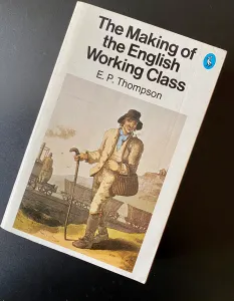
“There is a peculiarity in the town of Sheffield…….all classes of labourer dare to speak out the truth that is within them, ay, and labour while they think.”
Each had their own character and focus. The Mechanics Institute excluded books “deemed subversive” whereas the Sheffield Hall of Science was organised on democratic lines and opened by the co-operator Robert Owen in 1837 and stated that “ it was under the patronage of no-one”.
By the beginning of the 20th century ideas around adult education also began to change at this time. It finally came to be understood that once more people got the vote, they had to be better educated, both for work and society. In the past, it was thought undesirable to educate the working class, but now (in some circles at least) ideas had changed in favour of education for all. And some parents wanted literacy skills for themselves after seeing their children learning things at school.
Although a comprehensive plan for adult education was never really implemented, some public money
was made available to some organisations providing services for adults. As well as the local authority, the
universities with their Extension lectures and the Tutorial Class scheme, which gave people access to a
university education whatever their level of schooling. Other voluntary bodies such as the trade unions, National Council of Labour Colleges fought to keep their independence from the State.
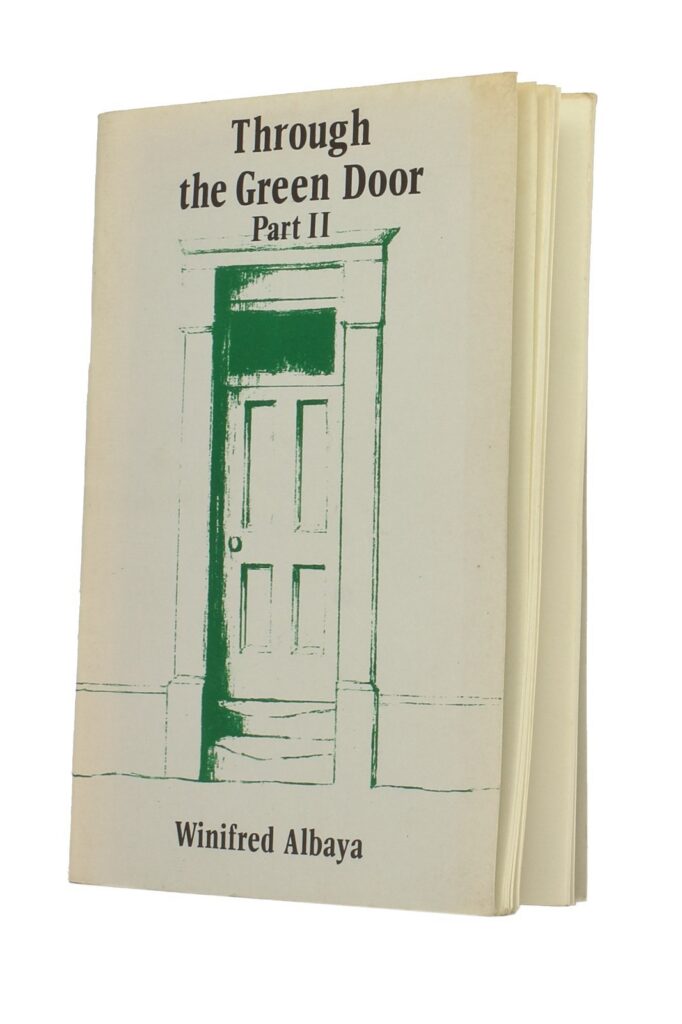
As part of a later university course Winifred Albaya wrote of the life of students in the Sheffield Educational Settlement during the 1930’s. Winifred’s partner Joe returned to his home country of Spain in 1936 to assist the Republican Government’s fight against fascism. Other students went on to prominent roles in politics, trade unions, business and civil society.
19th century schooling for children
In the early part of the 19th century there was no government involvement in education. Therefore,
voluntary individuals and groups took on the job of establishing schools for children and classes for
adults. However, many children received only a basic level of education, owing to irregular attendance at
poor schools. There were charity schools, church schools, grammar schools (largely for the middle class),
dame schools (used by working class families) and ragged schools (for the very poor), as well as Sunday
schools. In 1833 the government decided to make small grants available to the two main religious
societies already running schools. This was the first time that public money had been spent on education.
With this use of state funds came inspection and regulation, particularly after 1862 when grants were
handed out to schools according to a “Payment by Results” system. This was supposed to ensure that
money was spent appropriately and not wasted, but it had a stifling effect on the curriculum and
atmosphere in elementary schools. Some parents therefore preferred to send their children to one of the
many small schools run by private individuals, which could be less strict and maybe more homely.
Later in the 19th century there was a growing demand for a proper system of full-time compulsory
education for all children. It was recognised that the existing haphazard mixture of schools was not
satisfactory. In 1870 the Elementary Education Act was passed, followed over the next couple of decades
by further supporting acts of Parliament. The legislation stipulated that where there were insufficient
voluntary school places for the number of children in an area, then a School Board had to be elected and
had to provide schools paid for out of local rates, this money being in addition to the existing government
grants. These board schools, as they were called, catered initially for 5-10 year old children from working
class families; they offered a basic education, mainly in the 3 Rs (though as time passed increasing efforts
were made to broaden the curriculum). Fees were charged at first, but these were abolished in 1891.
Sheffield got onto this very quickly, and in the first ten years after the legislation, had built 21 new
schools.
In 1875, when he was invited to open Park School, the Liberal MP David Chadwick made this remark
about Sheffield’s enthusiastic response to the 1870 Elementary Education Act: How in the name of fortune
the School Board have persuaded the ratepayers of Sheffield to tolerate their extravagance in spending £100,000 in the building of 14 or 15 schools as substantial as so many castles. Many of these well-
designed and sturdy school buildings are still in use today, and have made a large impact on communities in Sheffield.
Although in the early years of state education there were ways of getting round the regulations on
attendance, by 1880 children had to go to school by law. Parents were prosecuted if their children failed to
attend school; they were fined and names and addresses of the responsible adults were published in the
local press. Education legislation was supported by various Factory Acts regulating hours of work,
working conditions and part-time schooling for children in employment. In some circumstances children
who had jobs could obtain a Labour certificate, exempting them from having to attend school. The
minimum leaving age kept creeping up, to 11 in 1893, 12 in 1899, and rising to 14 years in 1918. School
Boards lasted until the passing in 1902 of legislation for the provision of secondary education, when the
board schools were taken over by new local education authorities.
As Sheffield embarked on its ambitious schools building programme, voluntary provision became less
popular with parents. These developments in children’s education also had an impact on services for
adults. For example, the local School Board started to organise some evening classes, which at first werefor young people aged between 12 and 21, but later were open to anyone. From the late 1890s, many
people of all ages attended these local authority-run classes, which lessened the demand for services
previously provided by voluntary bodies.
By the 20th century, things were improving for children, but there were still many adults who had never
had the chance to get a decent education. In about 1918 a group of people were asked by Arnold Freeman,
who became warden of the Sheffield Educational Settlement, to write down their memories of being at
school during the late 19th and early 20th centuries. Many of them hardly went to school at all. If they
came from a poor family, even small fees of a few pennies a week were too much to pay, and anyway
children would often be at work, earning much-needed money. If children didn’t have shoes or decent
clothes to wear, then they might be kept at home. Some attended school part-time, and in that case they
would often be too hungry or too tired from working to be able to get any benefit from their lessons. It
was not unknown for children to fall asleep in school in the afternoon, if they’d had a hard morning at
work.
Like most working class children of that time, these authors didn’t have access to any form of secondary
or higher education. They would have attended elementary schools, which were certainly operating under
difficulties. From the 1860s to the 1890s the amount of government grant was related to pupils’ attendance
and achievement – both areas where it was easy for a school to fall short. Attendance could be spasmodic,
and levels of achievement were affected by such things as the size of classes (generally large), the school
environment and educational equipment available (generally poor), the type of teaching and learning
taking place (generally unimaginative and rule-bound), and above all the quality and availability of good
skilled teachers (definitely not enough of these). Eventually the regulations for the financing of schools
were changed and this, coupled with less rigidity in the curriculum, made for a better experience for
pupils and teachers alike.
Some children missed school through ill-health. Oscar D wrote:
I was about 5 years old when I started out to school. But unfortunately, was not able to keep it up, owing to having contracted consumption at 7years. … At 9 years of age, I went to a Private School, for, 13 weeks, my People Paying 1/- a week. but I could not keep it up, and had to stop altogether learning anything. I was 10 years old before I went to school again. then staying on till I left altogether at 14 years of age.
(Mrs) G C had to leave school because she was needed at home. She started school at the age of 3, but
when she was nearly 12 she had reached the 7th standard (the top class at the time), and having a delicate
Mother, who was not in a position to pay for help in the home, I thought I would leave school. (Because of
her young age she had to take an exam to prove the standard of education she had reached was high
enough to enable her to leave.)
I do think it should not be so easy for a boy or girl to leave school. One hour’s examination is a farce, and can be passed by children who really have had no Education whatever.
Joseph D was another child questioning why it seemed to be all right to leave school at a young age. He
wrote:
At the age of 12 years I left school to go to work, I attended night school two nights a week for
about five years. … I often thought I ought to have been going to day school. There seemed to be no
restriction about leaving school,when a lad looked big enough, and strong enough to work, he simply left,
to assist in helping to bring up some younger brother or sister. This system ought to be altered some time ago, for I feel that if I had been kept at school longer, I should have been able to have come on to the
labour market, more fully equipped to deal with the strenuous time with which labour demands.
Some of the children obviously enjoyed their schooldays, but it has to be said that some schools had
hardly any equipment, and taught a narrow range of subjects. Lemuel N, born in 1876 and at school
between the ages of 5 and 12, had this to say:
I had by some means at the age of twelve passed the fourth standard, thought to be with sufficient instruction. Physical Training, I have had none, Moral Training, negligent; the three “Rs” that I had spent most of my time upon was perhaps the best part of my work, and with those seven years I was considered to be efficient, both by the education authorities, and my parents; anxious myself to go into the industrial world for like most other youths horribly sick of school work I was to take my choice. My education had closed, the work shop was sought for.
As a contrast to this, (Mrs) A K, with experience of several different schools. It was her view that when school life came to an end every girl seemed sorry to leave. She wrote fondly of one as follows:
There was also a large library at this school and we could have a book out weekly. We also had a
special teacher once a week for cookery and one for cutting out and making garments. The one drawback here was there being only one teacher for standards six and seven, and as there were about sixty scholars in the two classes it was hard work for both teacher and scholar. On Wednesday afternoons a Major used to take us for drilling.
Returning to Lemuel N, he considered how his elementary school would differ from a secondary school,
where pupils enjoyed the advantages of the best modern equipment … small classes, each having its
separate and spacious room, the enlarged recreation ground with organised games and physical training,
the close cooperation of teacher and student and perhaps not lastly the best trained teacher.
Alas! I often think to myself how do I stand with my colleagues? what were the chances of educational advancement?…
As I have said, at the age of 13 toiling for my livelihood, exploited by my employer, at 14 drifted from
home. No parent, no school, no church, no pressure brought to bear. … What was to be the future?
These memories of schooldays have come from material in the Sheffield Educational Settlement Papers
held in the Special Collections and Archives department of the University of Sheffield Library. The
children going to school in Victorian times certainly had a limited education, and once they became
adults, many felt how unfair this had been. They were therefore keen to grasp any new opportunity to get
the education denied to them in their youth. Enter the Settlement movement, whose aim it was to help
equip people to live meaningful, useful and creative lives.
The Settlement movement
The first Settlement opened in London in 1885. More followed – some founded by religious and other
bodies, some loosely attached to universities. Each Settlement was different, but all grew out of the desire
to do something about the negative consequences of the Industrial Revolution, such as the increase in
class differences and poverty, particularly in urban areas. By becoming a part of the neighbourhood,
offering friendship and education to the people living there, the hope was that some of these gaps –
between the educated and the uneducated, the rich and the poor – would be bridged, and all would be able
to share a common life. Settlements had different priorities; for instance, some placed their emphasis on
social work, while others concentrated on art, music and recreation. All aimed to improve people’s lives
through the work that they did.
The Sheffield Educational Settlement
The earliest Settlements in Sheffield were developed by the Neighbourhood Guilds Association, which
was formed in 1897 and for a while ran services in two main locations, Neepsend and Shalesmoor. There
was also the Croft House Settlement, which was opened in 1902 by William Blackshaw. Croft House
Settlement Musical and Dramatic Society, now Croft House Theatre Company, was created as part of this
Settlement’s activities. They continue to put on musical theatre productions, with the original Croft House
Settlement building still open as a venue for many different groups.
The Neighbourhood Guilds Association Settlement in Neepsend lasted till the 1970s; the one in
Shalesmoor moved in 1908 to Shipton Street, Upperthorpe, but had to close in 1918 due to financial
difficulties. The YMCA then took over these premises in order to establish their own Settlement there.
Alterations were made, including the creation of a small stage for theatre productions, and in September
1919 the YMCA Settlement opened there with Arnold Freeman as warden. In about 1921 the YMCA felt
it couldn’t support this venture any longer because of increasing costs, but Freeman stayed on there as
warden for the new Sheffield Educational Settlement.
Settlements often had a residential element, and this was true of the Sheffield Educational Settlement in
the early days. Next to the Settlement premises at 3 and 5 Shipton Street was a large building on the
corner of Oxford Street. This was the Settlement hostel, with 3 and 5 Shipton Street being where all the
Settlement activities took place. In 1924 the Royal Infirmary took over the Oxford Street hostel, and the
open space behind it, for use as a nurses’ home.
In some ways the hostel was a great loss to the Sheffield Educational Settlement. During the mid 1930s
Freeman and other Settlement members bought a site near Castleton, called Hollowford. The hostel
situated there was used by the Settlement’s camping and hiking groups, and also by refugees in the 1940s.
This got people away from the city and into the countryside. Some attempt at farming was made at one
time, but it never really got off the ground. The Settlement sold Hollowford in 1946; it is now used by a
charitable trust running outdoor education activities.
In the press, the Sheffield Educational Settlement was sometimes called the backstreet university, or the
university of Oxford Street. In common with most other Settlements, it was established in a poor area, and
tried to plug the gaps in public welfare and education provision. There were many activities organised at
this Settlement, some in response to the social conditions of the day. Freeman did a lot of work with the
unemployed in the 1920s and 30s, and also with refugees in the 1940s. From 1941 to 1948, there was a
canteen at the Settlement, which proved extremely popular. Education work became less important after
World War Two, as the state took on more responsibility for services. For example, the Education Act of
1944, as well as setting out a system of free secondary education for everyone up to the age of 15, made it
obligatory for local authorities to provide facilities for adults.
Throughout the Settlement’s life drama was a really important part of the work done in Shipton Street, and
many plays were put on in what was called the Little Theatre. Freeman retired in 1955. He was followed
as warden by Christopher Boulton, who was also an enthusiast for drama. (Boulton went on to found the
Merlin Theatre.) In the following years there were a couple more wardens, but once plans for slum
clearance came into force, much of the housing in the area was demolished, and the Settlement’s days
came to an end.
HOW WE LIVED
In the early 19th century Upperthorpe and Netherthorpe were both largely rural, with farming as the main
activity. However, in the space of a few decades, following a huge increase in the number of people
coming to live and work in the area, the landscape changed completely. By the end of the 19thcentury, this
region was full of streets of poorly built houses, often back-to-back and frequently situated right alongside
workshops and other industrial buildings. There was no real planning when properties were built and
when streets were created. It was quite common for a builder to own just a small plot of land on which he
erected a few houses for the rental market as an investment. In these circumstances repairs were not
always done on time, so the houses deteriorated quite quickly, and people were forced to put up with some
dreadful living conditions.
Life in a back-to-back house
Back-to-backs were terraced houses with an additional shared wall at the back, giving people neighbours
on three sides. A number of these houses would be grouped together round a yard; this was called a court,
and formed the extent of the outdoor space available to the occupants of the houses. The aim of the
builder was to get the maximum number of dwellings onto his piece of land, so the houses themselves
were very small and lacked many of the amenities we take for granted today.
Take for example the issue of the supply and quality of water. Initially people got water themselves from
wells, springs and ponds, but as the population and industry grew this supply was nowhere near enough.
Even the provision of public wells and an artificial reservoir at Barker’s Pool could not fully meet
Sheffield’s needs.
Early attempts at providing an organised piped water supply for the town’s inhabitants
began in the 18th century with the construction of a series of small reservoirs near Hillsborough called the
Whitehouse Dams, built to catch water running off the moors. They were connected to other reservoirs in
the Crookesmoor area, but the supply remained inadequate. It was clear that much larger infrastructure
was needed, which ultimately was developed at Redmires, and in the Peak District. In time all the early
reservoirs apart from the Old Great Dam – now the lake in Crookes Valley Park – were filled in, and the
land used for housing, roads and public open space.
Meanwhile for the ordinary family living in a back-to-back house in the 19th century the water services
were often inadequate. When these houses were first built there was generally no fresh running water
inside the house. People had to use a shared tap in the yard. Sometimes the supply would be irregular, and
of course the water was cold. If you wanted hot water for anything, you had to fill a bucket from the
outside tap, carry the water into the house, and then heat it on the fire. In the yard there would be a
number of toilets shared amongst several families, plus one or more midden bins. These toilets were not
flushing toilets connected to sewers as we are used to today, and as a consequence people’s health
suffered.
It wasn’t just an issue with the provision of adequate toilets: getting rid of any sort of rubbish was a
problem. Much of it was just dumped in the courts, making things really unpleasant for the residents. The
courts themselves were often dark, being enclosed by high walls with perhaps a tunnel entrance to the
street. In addition, the outdoor atmosphere could well be smoky and polluted. Inside these houses people
had to put up with inadequate light and ventilation in cramped rooms which were often damp. There was
nowhere to store anything, no privacy, and arrangements for cooking were usually primitive. The smallest
back-to-backs were two rooms only – a downstairs room, and above it a bedroom. Difficult when families
were large, or if people had to take in lodgers to make a bit of extra money.
Things started to change in the 1860s when Sheffield’s local authority introduced a set of bye-laws
relating to controls on building, with the result that the construction of back-to-back houses was
prohibited. Other measures followed, to do with paving and widening streets, implementing adequate
drainage and sewerage systems for streets and houses, and improving standards of house construction in
general. Sheffield also acquired land for parks and recreation grounds, creating at least some open spaces
for the population to enjoy away from their homes. In spite of all this, there were still areas of Sheffield
which in the 20thcentury contained houses barely fit for human habitation.
Sadly, many of theUpperthorpe and Netherthorpe streets fell into this category, where totally inadequate houses were put up quickly, sometimes improved slightly as time went on, but then demolished wholesale and the residents relocated elsewhere, usually with no consultation about their wishes in the matter.
Children’s experiences
Two local authors have written about their childhoods in the area. Fred Pass (born 1942) grew up on
Martin Street, Upperthorpe in the 1940s and 50s, while twenty years earlier in the 1920s and 30s Ethel
Johnstone (born Aspinall in 1921) lived on Morpeth Street, Netherthorpe. She attended Netherthorpe
School. Both give details of what back-to-back houses were like inside and out.
Fred describes Martin Street, which was typical of the area, as “a cobbled street with terraced houses on
both sides, on the right the houses were slightly raised by a two-step pavement, where the houses had a
postage-stamp garden. On the left were terraced houses, whose continuity was punctured by an entry
which went downwards to a yard of back-to-back houses, hence the use of ‘court’ in the address, in our
case 19 court 5”. His was a ‘one up one down’ house, and he describes the downstairs room as follows:
the downstairs room had a cast iron fireplace to the right as you entered, a pot sink alongside and a single
gas ring. On the other side of the fireplace were two built-in cupboards, and a long top of about five feet
ending with a two-foot bottom cupboard. There was a coal cellar in the facing corner. Ethel describes her
downstairs room, highlighting in particular the equipment they had for cooking and washing. Opposite to
the oven was a hob with a lid where we kept sticks to light the fire. Some hobs had a brass tap and this
enabled families to keep a supply of hot water. … For cooking, pans and kettles were placed on the open
fire or a small iron grid that pulled down in front of the fire. A gas ring was also used for cooking. This
was placed on a wooden board covering the copper. On washing day, the copper was filled with water
which was heated by a small fire underneath then ladled into a wash tub to do the weekly wash using a
rubbing board and a peggy leg. This was a three legged contraption made of wood which was pushed and
turned up and down to agitate the clothes. Ethel tells us that the copper could also be used for boiling
food such as puddings. She goes on to say that neighbours helped one another so when a copper was lit
for cooking purposes whoever put a pudding in shared the expense of the coal or returned the favour.
Ethel’s house was a little bigger than Fred’s, having the room downstairs, one main bedroom, an attic and
a cellar. Fred’s house didn’t have an attic. He describes going up a wooden staircase to the (one) bedroom:
at the top of the stair was an alcove that had a curtain hung across the front of it to make an improvised
wardrobe. The bedroom had two double beds about six inches apart. Brian and me in one bed, mam and
dad in the other. There was no wallpaper on the walls because rain used to seep down the walls in bad
weather, so they were distempered a depressing blueish colour.
Fred’s family, in common with many people, had hardly any bedding; they used woolly jumpers and a
couple of old sheets and overcoats. Similarly their furniture in the downstairs room was very sparse; they
had a sideboard, a settee, a table and four straight-backed wooden chairs, a lino-covered floor and a
pegged rug in front of the fire.
Both Fred and Ethel describe the toilet arrangements. In Ethel’s yard was a row of toilets, each one shared
by two houses. We didn’t have toilet rolls in those days, newspaper was cut into squares and threaded on
to string which was hung on a nail behind the door. Fred’s household was in a worse situation: he says
there were six toilets in his yard, and six toilets and seven houses sounds OK, but those six toilets, or
closets, as we called them, not only served us, but about a dozen other houses on Martin Street. We were
lucky that the toilet we used was in our yard.
Fred was aware that though these conditions were undeniably sparse, we were, in some ways, lucky, for
there were only four people in our house. Some families of ten, or more, lived in identical conditions. Fred
and family left the Martin Street house in 1952 when he was about 11 years old. They moved to
somewhere more spacious – two bedrooms, an off-shot kitchen, and an outside toilet all to themselves.
Ethel came from a larger family than Fred’s, and in her account she describes some of her family’s
experiences with illness. Living in back-to-back houses was not conducive to good health. Infectious
diseases spread very quickly, and in fact Ethel herself contracted diphtheria when she was five, and was
dangerously ill. Just after she was discharged from hospital, her 11 month old twin siblings were admitted to the same hospital with double pneumonia. Sadly both died, and Ethel makes the observation that
families in those days really did suffer great hardships and tragedies.
When Fred Pass and Ethel Aspinall were living in their childhood homes, the houses were already old and
deteriorating. As a contrast, Winifred Albaya (born Turton in 1911) wrote an account of what it was like
living in Townhead Street in a flat which was part of the first slum clearance and rebuilding carried out by Sheffield council. These flats were built to a much higher standard than the typical privately built back-to-
back house.
The Townhead Street flats date from 1902. The aim was to provide good working-class housing,
supposedly at affordable rents. However, the rents were by no means cheap, which put these blocks of
flats outside the reach of many of the poorer families. Winifred writes that each block had three flats on
either side of a flight of stone steps. … Ours was the top flat, and the front door opened directly into the
living room, which had a large Yorkshire range, flanked by cupboards, facing the door. On the right hand
wall, a door led into our one bedroom which overlooked Townhead Street, and on the left hand side,
opening directly from the hearth, was another door which led into a so-called ‘kitchen’ which was nothing
larger than a cubby hole. The living room was lit by a high sash window which looked down into the
communal yard, and a low cupboard under the window served as our pantry.
But to return to the kitchen – This had a copper or wash boiler with a little fire grate underneath, which
was lit from the coals of the living room fire. A stone sink with one cold tap, and a heavy iron mangle, or
wringing machine, together with dolly tub, completed the furnishings of the kitchen, and from there,
another door led on to the open landing surrounded by iron railings: here was our WC and coal bin.
Some flats had more than one bedroom, but note that there was no bathroom. Though the toilet was
indoors, it was situated outside the flat on a landing. This landing was also where the family kept their tin
bath, hung up on a nail. On bath night, the bath was brought into the living room, put in front of the fire,
and filled using a kettle to heat the water.
Washing day was a real chore. Winifred writes that in our cubby hole of a kitchen my mother toiled all
morning, boiling the clothes in the copper, pushing them in the tub with the wooden dolly-legs, rinsing,
mangling, blueing and starching. The folded clothes were carried down to the yard in a clothes basket,
and hung out on lines from wall to railings. The yard on Mondays looked like some festive occasion of
flags and banners as sheets fluttered in the breeze, on a fine day. … A wet washing day was nothing short
of a disaster, with our limited drying facilities. Sheets hanging in a small, damp, steamy living room were
not very welcoming for father when he came home to tea, especially as we were restricted to sitting in a
small space on the hearthrug all evening. But I thought it was great fun running up and down between the
sheets, pretending they were tunnels, and I was a train.
Though Winifred’s flat inside was superior to a back-to-back house, it had some of the same faults. There
wasn’t much outdoor space for families and the lack of facilities indoors meant that doing the washing, for
instance, was still very hard work. Winifred makes this general point about life in those times: It was like
being aboard a precarious raft where many people of all ages were crowded together. When frequent
heavy waves washed up onto the raft and swept some of them overboard, willing arms were stretched out
immediately to rescue them, though some went under and could not be rescued.
Winifred and her family left Townhead Street in March 1922, when she was 11 years old. They moved to
a new council house in Firth Park. As she puts it We settled down to enjoy the benefits of electric light, hot
and cold water, a bathroom and the joy of a garden. Best of all was the awareness that the real, true
countryside began at the end of our road, five minutes away.
Alley and court concerts start in Martin Street
Now we leave Winifred’s account of her escape to Firth Park, and return to the story of people who had
the misfortune to live in the tiny back-to-backs in dark, unhealthy courts. Life was pretty grim, but there
was at least one attempt made by the authorities to brighten things up. This was an initiative called “alley
and court concerts”. Outdoor concerts were already organised in Sheffield’s parks, but at one period
concerts were also brought right into the courts.
Picture the scene: a piano comes on the back of a lorry and is wheeled from the street into the court. A
stage is erected, and seating brought in. People assemble, waiting for the entertainment to begin. The
programme is free and has been set up just for them. There are no strings attached – it literally is
something for nothing.
These court and alley concerts were put on by Sheffield’s Parks Committee each year from 1903 to about
1912, and usually took place once a week during the summer months. They’d be held in a different court
each week, and the programme would vary according to who the performers were. Some would be like a
variety show, with a mixture of singing, instrumental pieces, and comedy sketches. Others would be
purely musical in content. The idea behind them was to bring entertainment to the actual places where
people lived, particularly where conditions were dreary and difficult. The first of these concerts was held
in May 1903 in Court 11, Martin Street.
Apparently these concerts were very popular particularly at first, but the decision was taken to stop them
in 1912 because other forms of entertainment such as going to the cinema (or picture palace, as it was
called) were becoming increasingly available to people. Possibly the feeling was that the court and alley
programme had served its purpose, and the money could be better spent putting on more open-air concerts
in traditional spaces such as the parks. However, concerts in the courts were resumed in 1925, but stopped
again for good at the end of the 1933 season, the reason once again being that conditions had changed,
lessening the need for this provision. In particular, many more households had a wireless (radio), and
some of the slums were now actually being demolished.
Sheffield wasn’t the only place to put on this sort of concert. At the turn of the century court and alley
concerts were becoming established in a number of different towns and cities, for example in Liverpool,
Manchester, Birmingham. All were popular, often with huge audiences squashed into a small courtyard.
Perhaps the concerts were sometimes raucous affairs! As regards the performers, it could well have been a
bit of an eye-opener for them if they’d not ventured much into slum areas before.
All change as slums disappear
Martin Street has featured a few times in this account of life in Upperthorpe and Netherthorpe. In many
ways its history has mirrored the history of the area. So finally the houses in this street, together with
many of the buildings in the surrounding districts, eventually became the subjects of slum clearance and
compulsory purchase orders. These orders were originally drawn up in the late 1930s, but were only acted
on fully in the 1950s and 60s, when a great deal of demolition and rebuilding took place. In Upperthorpe
the buildings from that time include bungalows, maisonettes and seven tower blocks, which take their
names from the old streets of the area – Wentworth, Adelphi, Martin, Burlington, Bond, Albion and
Oxford. Martin Street runs alongside these tower blocks; it’s not a through road and in fact in places is just
a footpath, but it does follow the line of the old Martin Street.
Demolition in Netherthorpe began in the 1950s, with new housing in the form of tower blocks and
maisonettes built in phases. As part of this reconstruction of the landscape, a brand new major road was
created, running from Brook Hill to Shalesmoor, with a large roundabout at the Brook Hill end. This road
is now also a tram route. In the midst of all this urban development an area called the Ponderosa was left
for recreation. The four Netherthorpe tower blocks were completed in the early 1960s, and are called
Adamfield, Cornhill, Robertshaw and Crawshaw.
What of the families living in these areas earmarked for demolition? Once an area was cleared and
everyone had to move out, should people try to find somewhere local to live, or should they start afresh
and move away? Those electing to remain would probably already be living near to their work, so there
would be no increase in transport costs, or in time spent getting to and from work. The area would be
familiar, so any sense of belonging would remain, unless of course all their neighbours had chosen to
move away. Some people looked for an area similar to the one they had just left, but in that case the
housing was likely to be poor, but it would be cheap. For those families going to one of the new council
estates, they would undoubtedly end up with a much better house (with a kitchen, a bathroom, a garden,
and much more living and bedroom space), but this would come at a price. The rent would be
significantly higher, and people would be wanting to buy better furniture and equipment for the new
house. As well as these expenses, there would probably be additional transport costs to get to work. It was quite a decision to make, but I imagine most people – provided it was affordable – would jump at the
chance to have a lovely modern house with plenty of room for everyone. No doubt it was poverty which
made people choose otherwise.
Ewan MacColl wrote the song “Dirty old town” in 1949. It is about his home town of Salford, but could
almost equally well apply to Sheffield. Here is a link to a YouTube video of him singing the song with
Peggy Seeger; it includes some scenes of the Manchester area.
How We Worked
For centuries Sheffield has been in the business of producing iron and steel, and making tools, cutlery and
other goods from these materials. These metal trades, utilizing traditional manual craft skills, began in
rural forges and workshops which were initially powered by water from Sheffield’s rivers. Once the
change from water-power to steam-power was made, many of these industries moved to the town and its
immediate outskirts, where large factories were built employing hundreds of people. There were still
many small producers – the “little mesters” – often doing work for these factories according to their own
particular specialism, but inevitably the old craft skills and ways of working started to disappear.
Mechanization, though resisted in some quarters, had to come eventually as a response to new
technologies and competition from abroad. Sheffield played a major role in the innovations of the
Industrial Revolution, but as people’s working lives changed, so their rights to safe and decent working
conditions were often bypassed.
Conditions at work
In the early 20thcentury some efforts were made to improve conditions for workers using evidence from
factory inspections and critical reports written by medical officers, but it was a slow process. Some
traditional Sheffield occupations, for example the grinder and the file-cutter, were classified as dangerous,
so what was it like to work in these jobs?
This folksong gives some clues: YouTube clip Grinder’s Hardships (Sheffield Grinder) – Lyrics & Chords
To learn more about ordinary workers and their jobs, we can turn to a piece of research conducted just
after World War One by the Sheffield Educational Settlement (which was based in premises on Shipton
Street, Upperthorpe). The aim of the research was to find out what work was like for people in manual
occupations, and to discover what influences the type and place of work had on them as people – on their
character and on their attitudes to life. This research project was never finished, but as part of the material
gathered for it there were some personal accounts written by people about their work.
Sidney S, tool fitter
Sidney S had a lot to say about his working environment. He was born in Sheffield in 1883 and had a
difficult childhood because his father, a cutler, died at the age of 27 when Sidney was only 18 months old.
At the age of 11 Sidney was earning money which was much needed by his family:
I got a job as assistant to a barber. In other words I became a lather lad. Worked at it Wed and Friday nights from 5-30 to 9, and all day Sat from 8-30 the morning until 11-30 at night. Then after leaving school at the age of 13 he started working full time (that is, for 54 to 60 hours a week), first as an errand boy, next as a cutler,
and then for 20 years as a tool fitter.
Sidney wrote that in this job he felt he was just a number; he likened it to being in prison because the work was so hard and monotonous. He describes the tool workshop as follows: It is a brick building, or series of buildings – bricks coloured with Sheffield’s unique atmosphere – contained in an oblong.
There are two stories with lathes, drilling and milling machines both upstairs and downstairs on one of the long sides of the factory. On the other long side with the warehouses overhead is the ‘wheel’ – grinding wheel to be precise – containing two wet stoves, two emery wheels (dry) and several spindles whereon glaziers are run. This place calls, nay, shrieks for special mention. It shall have it as far as my descriptive powers and language both hopelessly inadequate for the purpose will allow. It is a wondrously dirty ‘hoil’ which somebody should be jolly well ashamed of, with four small windows – three with glass panes which keep out the light (must be seen to be believed) and a fourth with iron bars only which allows the passage of light, also of winds and rain andsnow – and a tremendous smell.
He remarks that there is a fan, but it is too small and not sufficiently powerful to carry away the dust that
flies from emery wheel and glazier with the result that there is an accumulation on walls and ceiling
(this very low) and, could one see it, not a little on the lungs of the unfortunate people – mostly women – whose industrial lot is cast in such a fearful place. Also there is much dust flying in space, and this is so thick
and congealed with glue and oil that it strikes those who needs must make enforced entry into the wheel in
big lumps.
He talks of the gas stove, but this doesn’t give out any warmth because there’s not enough fuel, and the
burners are choked with the all pervading dust. Factory acts and inspectors you enquire. “What of them?
Yes, what of them, and more particularly the latter? Thats what I want to know.” … I have known three
men contract consumption in that wheel. Two of these are dead, the other is dying. Next to the wheel, on
the same level, is the plating and finishing shop, another dusty place in which, again, there are the main
essentials to the health and comfort of the people occupying it, conspicuous by their absence. The shop in
which I work is on one of the short sides of the building and directly over the engine house. It is so placed,
too, that it catches the full heat of the afternoon sun, and in Summer it is uncomfortably warm to say the
least of it.
In short, Sidney would be happier if his workplace was better lighted, with a more suitable, even
temperature, less dust and proper ventilation. The noise we accept as inevitable, but we don’t accept so
philosophically the lack of some provision to enable us to get our dinners in some small measure of
cleanliness and comfort.
He also comments on the lack of opportunity that they all have to develop their talents in their work.
Though Sidney himself was born in Sheffield, his father and paternal grandfather were both from
Lincolnshire, and his maternal grandfather from Nottinghamshire. Sidney was well settled in Sheffield
and married Edith in 1909, and they had children. Shortly after he wrote this account of his working life,
he got a job at a Sheffield power station. Sidney died in 1968 aged 84.
Jack H, silver plate worker
As Sidney wrote, it was quite common for there to be no canteen for meal breaks. People often brought
their own food to work; they would eat it in some part of the factory or factory yard, or even in the street
outside. Alternatively they could buy something to eat in one of the many small cook shops in the area.
Jack H, a silver plate worker, commented that
There is very little room to knock about in the factory yard. Every possible inch of ground is utilised for some sort of necessary structure. … At the ‘gate’ there is a corner pub which is a boon & blessing to some, & next door to the pub there is a little house window shop to which the workers are allowed to go for cigarettes, sweets, cakes & cheap dinners, etc.
Jack was born in 1885 in Sheffield. He came from a large family of 14 children, where only 7 of them lived to adulthood. His father, a worker in the steel industry, died in 1900. Jack himself worked as a silver holloware finisher for a silver and electro-plate manufacturer. He married Ethel in 1912, eventually
having two daughters. Jack served in the army in World War One from 1915; he spent two years in
France, and was away for four years in total. On his return he felt out of touch with his job and in fact
shortly after writing his piece about silver plate working he got a job as a clerk in Sheffield; he finished
his working life as an insurance manager in Chester-le-Street, county Durham. Ethel died in 1968, and
Jack in 1973.
Lemuel N, railway worker
Many workers felt they had no power in the workplace. Holidays could be a difficulty. Lemuel N was
born in 1876 in Middlesex, and spent all his life there. He started work as a railway porter, and later
became a railway signalman. Lemuel married Ellen in 1899, and had three daughters. Ellen died in 1959;
Lemuel in 1968. In his account he wrote:
A final word now in regard to the annual Holidays (six days) granted to each of the employees. It is the practise for the responsible official to prepare a “Roster” at the commencement of the holiday season. This list is prepared I believe with all good faith, unfortunately Signalman are not consulted and often the times fixed are not suitable. If they were it is but very rare that the times are adhered to. Men go off sick, abnormal working often becomes the rule. The relief staff is inadequate to meet the exigencies and at the eleventh hour leave is cancelled probably for another three weeks or so. It is not possible to make any initial arrangements if one wishes to take a journey with their family to some seaside resort it invariably happens that the sanction arrives too late the train is gone, and one day of the six is gone. … A protest meeting was held a few days since demanding an alteration andproper system established in order that Signalmen should not have differential treatment to any othergrade.
Lemuel also mentioned that he would like more weekends off, so that he and his family could take
advantage of all the new forms of transport to go and visit friends, or have a day out in the countryside.
He asks: How long are we to be so submissive to industry?
Railway porter
The problems of wages, tips and opportunities at work were raised by an anonymous writer working as a
railway porter.
It might be admitted at once that as to Porters duty there is no limit seeing he is the lowest
grade that wears the uniform & he is there for the use of his superior officers & for the convenience of the public so nothing is too small or great if he is asked to do it as he isn’t important enough to say yes or no.
… Now about Wages & Tips, up to the war a porter in a large town could not live on wages only, The
Company knew this, public too, but the inconsistency of this is the company forbid them to be taken, yet
pay a wage which compel a Porter to take them or starve & then the unequal distribution is injustice as in
many cases say at large Stations a good man is placed in Position whereby tips run thin & men who are
not so trustworthy doing the ordinary work remaining in the Position to get the largest share, as there is
difference in men it has always been so, as regards Promotion he have to wait his turn & in many cases he
is qualified years before the opportunity presents itself.
Buffer girls and women at work
Several of these accounts were written by a researcher visiting different places of work. One such report is
on the working environment of a buffer girl:
The workers in the buffing shops are chiefly women. The buffer girls of Sheffield wear a special head-dress – a red hankerchief worn in a certain way, and said to be a survival from Mediaeval times. They can be recognised anywhere with their clothes and hands & faces blackened by their work: their sleeves rolled up above the elbow and this red head-dress. …
The shops are indescribably dirty owing to the quantities of fine black sand which fly off from the wheels of the machines. This settles everywhere, on the clothes of the worker, and especially it covers the windows
making the shops very dark. The work in spite of its unpleasant character is highly skilled, and it takes
several years to turn out an efficient buffer. … The buffer is standing at the machine most of the day,
dealing with perpetual blackness. She has to scoop up black sand from a heap of it that lies by the
machine, and hold it with the article she is buffing against the machine. The revolving wheel sends it
flying all over her clothes, face, and arms. Outside the buffing shops there are certain sinks in which the
buffers wash at intervals. They are carefully cleaned at least twice a day, but after being used their
appearance is indescribably dirty. This is chiefly unavoidable, but buffers have been found sitting on a
ledge with their feet encased in heavy boots in the sink.
Apart from the buffer girls, very little has been said so far about women and their working lives. Women
did work alongside men in some industries (usually for lower pay), and they also worked in what were
typical female occupations, for example as domestic servants, charwomen, dressmakers, laundry workers.
However, in general men were more economically active than women, except in both world wars, when
women stepped up to fill men’s places in many sectors of work. A lot of women did not have a paid job
after marriage, which was a huge waste of talent, but it must be remembered that they did a great deal of
unpaid work in the home – work which itself was physically demanding as well as time-consuming.
Someone has to do this work, and how could men share these home tasks equally with their wives after
their own long day of exhausting work?
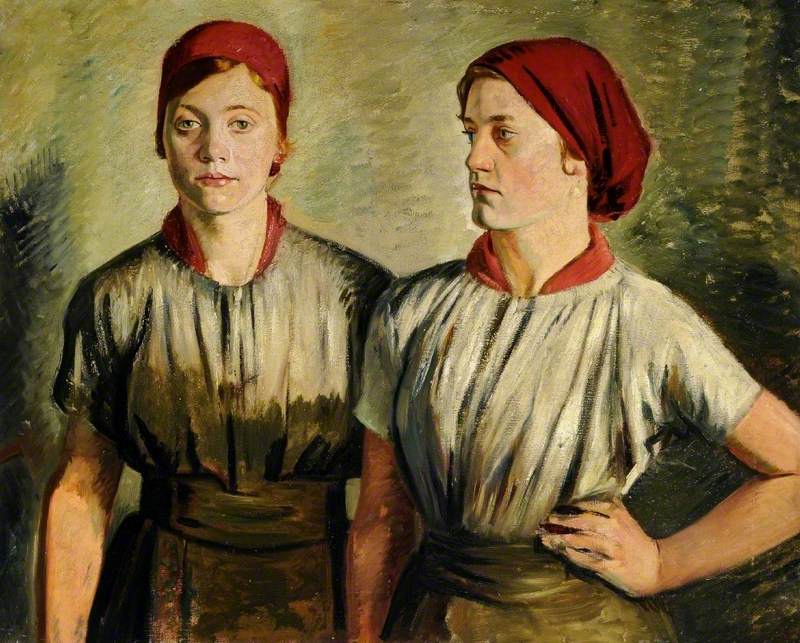
Buffer girls with their trademark headgear of red and white. This painting hung in the Sheffield Educational Settlement.
The colours of red and white would be chosen as the colours for Sheffield United.
Last word from Sidney S
Sidney S described his workmates as follows:
Well then see my mates as they homeward wend their truly weary way, with fagged looks on their soiled faces, shiny patches of grease (the accumulation of months) on waistcoat and breeches (we don’t wear overalls, can’t afford ’em) indifferent boots on their feet, knitted scarves round their necks and a generally untidy appearance. You can’t make any mistake about the members of small tools trade for they carry on their person and clothing the mark of their craft.
And he comments that as for himself:
no one is better aware of the need for immediate rest and refreshment by the men after their day’s work – work that is as hard as it is monotonous – is over. … please remember the
educational advantages, or lack of them, that all of us have had.
Unemployment and a new direction for Sheffield
It has already been said that at some points in Sheffield’s history there have been great work opportunities,
and hence many periods of full employment. However there have also been periods of depression,
unemployment and short time work, and one of those times occurred during the 1920s and 30s, when
Sheffield suffered unemployment as never known before, causing much hardship. In fact, by the end of
the 1920s, Sheffield had one of the highest unemployment rates in the country. Census records can
provide evidence for this.
Taking the houses in Court 19 on Martin Street, Upperthorpe, we can compare data from the 1891 census
with the 1921 census. In both those years there were roughly the same number of residents in Court 19 –
28 in 1891 and 31 in 1921 – but whereas 16 people in 1891 were economically active, only 6 were in 1921 (and of those six, only one was in a metal-related trade). None of the heads of households were out of
work in 1891, as against 8 in 1921. This reflected the general picture in Sheffield in the early 1920s.
Mention has been made of the Sheffield Educational Settlement on Shipton Street. Arnold Freeman, the
warden at the time, put a lot of effort into supporting the unemployed during the 1920s and 30s. He set up
a craft scheme, so that people could be trained in trades such as carpentry, and then have the opportunity
to sell their work. There was also a printing press at the Settlement, which was used to do all the printing
for that organisation, and for any outside orders that might come in. Freeman used his many contacts to
try and get jobs for Settlement members (who could join at a cheap rate if they were unemployed). He
also, together with some colleagues, bought some land and buildings near Castleton, which were
refurbished and used as a hostel to give poor families a bit of time away from Sheffield.
Sheffield’s industries have been through many ups and downs since the hard times of the 1920s and 30s.
In particular, the economic problems and policies of the late 20th century have resulted in the destruction
of much of that industry, along with the infrastructure and landscape that went with it. The specialist steel
sector has developed and survived, together with other high tech engineering, but new areas of work have
now come into prominence, including education (with Sheffield’s two universities), and sport and leisure
facilities. There have been many changes since Sidney S described his downtrodden workmates.
THE LITTLE THEATRE
How did people spend their leisure time before the age of the radio, cinema, TV and all the online services
on offer today? Mention has already been made of the alley and court programme of concerts in the early
20th
century. Other popular forms of live entertainment were provided by music halls, theatres, dance halls
and sporting events – and of course people have always gone to pubs and clubs to be with their friends and
neighbours. Unfortunately ordinary people couldn’t socialize at home because their houses were too small
to accommodate such meetings.
Drama in Sheffield
The first proper theatre in Sheffield was built in 1763, and by the 19th century there were many theatres
and music halls. There was also a thriving amateur theatrical scene in Sheffield, and it was no surprise that
right from the start the Settlement in Shipton Street had a drama society. Eventually their very own Little
Theatre was created on the premises, and many plays were performed there in the over 40 years of the
Settlement’s existence. Starting in 1919, the plays were produced by Herbert Prentice, with his wife
Marion taking many leading roles. The Prentices had ambitions to establish a permanent professional
repertory theatre in Sheffield, so with this in mind they branched out independently of the Settlement, and
did indeed form the Sheffield Repertory Company, which in time became entirely professional. They
eventually occupied a building on Townhead Street, which was named the Sheffield Playhouse. The
Company operated for many years from these premises, subsequently moving to the newly-built Crucible
Theatre.
The Sheffield Playhouse and later the Crucible were pioneers of children’s and experimental theatre; staff
did outreach work in schools, and sought to involve local communities in drama. Two children’s groups –
Pegasus Theatre and Sheffield Theatre Vanguard – both performed at the Little Theatre during the 1960s.
The Shipton Street Settlement wasn’t the only Settlement in Sheffield to engage in dramatic work. Croft
House Settlement was opened in 1902 by the Rev William Blackshaw using premises in Garden Street.
The aim of the organisation was to provide educational and recreational facilities for the local population,
and included in this was a section called the Croft House Settlement Musical and Dramatic Society. In the
early years this society’s shows were performed in the Garden Street building; later they used other
venues. The society has been through a few name changes, and exists today as the Croft House Theatre
Company.
Drama at the Sheffield Educational Settlement
Once Herbert and Marion Prentice had left the Settlement on Shipton Street, Arnold Freeman as warden
took full control of its dramatic work. He regarded drama as the most important of the Settlement’s
activities, because in his view many of the great thinkers in history have chosen to write plays as a vehicle
for their thoughts – and these thoughts were what Freeman wished to see explored and presented to an
audience.
Freeman had a particular way of working. He didn’t ask people to learn lines straight away; instead he
organised a series of classes to examine the playwright’s ideas, and the context in which the play had been
written. The process of learning together about the play was the vital thing; traditional rehearsals came
later. Ideally Freeman wanted everything to be produced in-house, as a collaborative effort – costumes,
scenery, props, lighting, music. And on the publicity for the plays usually no cast members’ names were
given; there were no stars here, as everyone’s contribution was of equal value. Freeman sought to
introduce great works to ordinary working people, hoping to help them to an appreciation of the best
literature, and to enrich their lives in the process. His aims were educational rather than pure
entertainment.
This account of drama at the Settlement makes it sound as if it was a really solemn business. Of course
the intentions behind the work were serious, but there were definitely lighter moments, including some of
pure silliness! Some popular and humorous plays were chosen, particularly at Christmas. Freeman himself
wrote a few of these plays, and he was also the author of a number of little scenes or sketches which were performed at Settlement Christmas and after-show parties. Doing drama at the Sheffield Educational
Settlement must have been hard work, but also good fun and very involving.
After the Little Theatre
Unfortunately, unlike the Croft House Theatre Company and the Garden Street centre, there is now
nothing left physically of the Little Theatre and the Settlement; however its influence can still be seen in
organisations which exist today. Just as the Playhouse, and then the Crucible, developed from the
Settlement’s drama society, so another theatre was created by the warden who succeeded Freeman.
Christopher Boulton served as warden at the Sheffield Educational Settlement from 1955 to 1961, and
carried on its dramatic tradition at the Little Theatre. After Boulton left the Settlement he went on to found
the Merlin Theatre at Nether Edge, which is a theatre and arts centre run by the Ruskin Mill Trust. During
the early 1960s there were a couple of other wardens at Shipton Street, but it is not known to what extent
drama was pursued by them as an activity.
The Settlement was starting to fade away, but the building was certainly used by a number of different
groups during the 1960s. The evidence for this lies in newspaper advertisements; for example, in June
1967 an advert in the press invited young people to join a group which was meeting regularly in the Little
Theatre on Tuesday evenings for talks, parties, theatre and concert visits, and in June 1969, as part of the
University of Sheffield’s Arts Festival Fringe, the Playhouse Theatre Vanguard performed an item there.
The venue was also used for such things as band rehearsals. So some events were being put on at the
Little Theatre as late as the end of the 1960s, but they must have taken place in a changed landscape.
There was no Settlement as such, and the building itself was probably one of just a few still standing. It’s
possible that practically everything else round about had been reduced to rubble. Rather a sad ending for
such a busy organisation which in its time had been so full of energy and plans for the future.
Many would regard most of the plays put on at the Settlement’s Little Theatre as serious drama. Indeed,
Freeman’s approach and the material he used, differed enormously from the programmes on offer in the
many other theatres and venues of the time. It is interesting to consider what were the competing forms of
entertainment during the Settlement’s existence.
Entertainment for the people: music halls to cinema to television
The music hall type of entertainment – usually consisting of variety acts – was really popular from the
early Victorian period right into the first part of the 20th century. There would have been an informal –
even raucous – atmosphere, with people often joining in the songs, and shouting out with their opinions
about the performances. At first the audience in music halls was allowed to eat, drink and smoke in the
auditorium, though that did change in later years. Each evening there would be a wide range of acts, with
lots of comedy. This was affordable entertainment for working people. The popularity of the music hall
started to decline after World War One. Tastes seemed to have changed, and there was much competition
from new providers of entertainment, such as the cinema, the radio/wireless, the gramophone/record player, other forms of music such as jazz and the big bands, often as an accompaniment to the ever-
popular dancing, and of course there was television.
All these new things affected how people chose to spend their leisure time, and where they went for their entertainment; in turn these new habits were reflected in the buildings of the neighbourhood.
Some early pioneers of cinema, such as Jasper Redfern and the Mottershaw family, lived and worked in
Sheffield. At first they would travel around, showing their films in existing halls, often alongside variety
and even circus acts. But things were changing in the film world. In 1910 the first purpose-built cinema in
Sheffield opened on Union Street, and many more cinemas – or picture palaces, as they were called – were
set up in the town centre and the suburbs. By the outbreak of World War Two there were about 50 cinemas
in Sheffield, some of which had additional facilities such as ballrooms, billiards rooms and cafes. As a
result many theatres either closed down, or changed to being cinemas, particularly once most of the films
shown were “talkies”. But cinema’s popularity eventually waned, as going to see a film couldn’t compete
with the entertainment which people were starting to be able to access at home on their TV set. Once
television became popular and more affordable, everything changed. This time it was cinemas closing
down, often with the building re-used for other purposes.
Shipton Street provides an example of this trend. At the Addy Street end of Shipton Street there had been
a Unitarian chapel with associated Sunday School. Upperthorpe Chapel, as it was called, was newly-built
in 1861, but by 1913 its congregation had drifted away, and services were no longer held there. The
building was converted into the Oxford Picture Palace, and opened for business in December 1913. After
something like 50 years as a cinema, it closed in 1964, and was then used as a warehouse. The Sunday
School is labelled on maps from the 1950s as a hall (possibly for snooker and billiards) and then in the
late 1960s it became a garage.
All change for Shipton Street, home of the Little Theatre
Shipton Street started life as a short narrow unnamed lane situated off Oxford Street, with just a few
scattered buildings in the immediate vicinity. On the 1871 census it is referred to as Chapel Street or
Chapel Lane, which is hardly surprising seeing as from 1861 there was the Unitarian chapel at the end of
it. Later on it became a proper road and was given the name Shipton Street. The whole area was then
heavily built on with new streets created and new buildings erected, including some very poor quality
housing.
Eventually during the slum clearance programmes carried out after World War Two, a great many
buildings were demolished, bringing major changes to the landscape. Shipton Street itself was widened,
and on the south side of the road – which is where the Settlement was – some bungalows were built. Not
much from the 19th century remains here, and it is now an area of mixed housing with some green spaces.
All very different from the pollution and grime of 150 years ago.
Bibliography
Sheffield Educational Settlement Papers, University of Sheffield Library’s Special Collections and
Archives
Sheffield Daily Telegraph
Picture Sheffield, Sheffield City Archives Picture Sheffield
www.findmypast.co.uk for census and family records
Winifred Albaya
A Sheffield childhood 1911-1922
(Sheffield : W Albaya, 1984)
Winifred Albaya
Through the green door : an account of the Sheffield Educational Settlement, Shipton Street, 1918 to
1955. Parts 1 and 2
(Sheffield : Sheffield District Education Committee and Author, 1977)
Clyde Binfield, Richard Childs, Roger Harper, David Hey, David Martin, Geoffrey Tweedale
The history of the city of Sheffield 1843-1993. Volume 2, Society
(Sheffield : Sheffield Academic Press, 1993)
John Burnett
A social history of housing 1815-1985, 2nd edition
(London and New York : Routledge, 1986)
Margaret Drinkall
Struggle and suffrage in Sheffield : 1850-1950
(Yorkshire : Pen & Sword History, 2018)
Enid Gauldie
Cruel habitations : a history of working class housing 1780-1918(London : George Allen & Unwin Ltd, 1974)
Richard Hoare
Sheffield Adult schools, 1850-2012 : from Quaker evangelism to “friendship through study”
(York : Quacks Books, 2016)
William Ibbitt
View of industrial Sheffield from the south east (painting done in the 1850s)
Picture Sheffield ref y14554 at Searching Picture Sheffield
YouTube clipTalking Art by Sheffield Museums at Talking Art: South East View of Sheffield by
William Ibbitt
William Ibbitt
West view of Sheffield, showing New Dam, Old Great Dam and Dam House (painting done in 1855)
Picture Sheffield ref w02070 at Searching Picture Sheffield
Ethel Johnstone
Growing up around Meadow Street in the 1920s and 1930s
Peter Machan
The little mesters : the rise, decline and survival of Sheffield’s traditional trades
(Sheffield : ALD Print Ltd, 2023)
Christine Minter
The Crofts : Sheffield’s long-lost community
(Sheffield : Arc Publishing and Print, 2022)
Fred Pass
Weerz me dad? : a collection of autobiographical childhood stories of the 40s and 50s
(Sheffield : ALD Design and Print, 2001)
Sidney Pollard
A history of labour in Sheffield
(Liverpool : Liverpool University Press, 1959)
Ian D Rotherham
Steel city : an illustrated history of Sheffield’s industry
(Gloucestershire : Amberley Publishing, 2018)
J Edward Vickers
A popular history of Sheffield : with a guide to places, buildings and things of interest
(Wakefield, West Yorkshire : EP Publishing Ltd, 1978)
Victorian Society
Building schools for Sheffield 1870-1914
(Sheffield : ALD Print, 2012)
YouTube clip Grinder’s Hardships (Sheffield Grinder) – Lyrics & Chords
YouTube clip DIRTY OLD TOWN ORIGINAL – YouTube